
Japanese SEO Spam
Japanese Keyword Hack Fix for WordPress: Clean the Site and Get the Spam Out of Google
The Japanese keyword hack fills Google with thousands of fake Japanese pages on your domain. I remove the infection and its backdoors, make every spam URL return 410 Gone, submit spam sitemaps so Google re-crawls them quickly and track the indexed count in Search Console until the spam is gone.
- Building for clients since 2021
- 25+ live client websites
- Clients in the US, UK, Canada & Europe
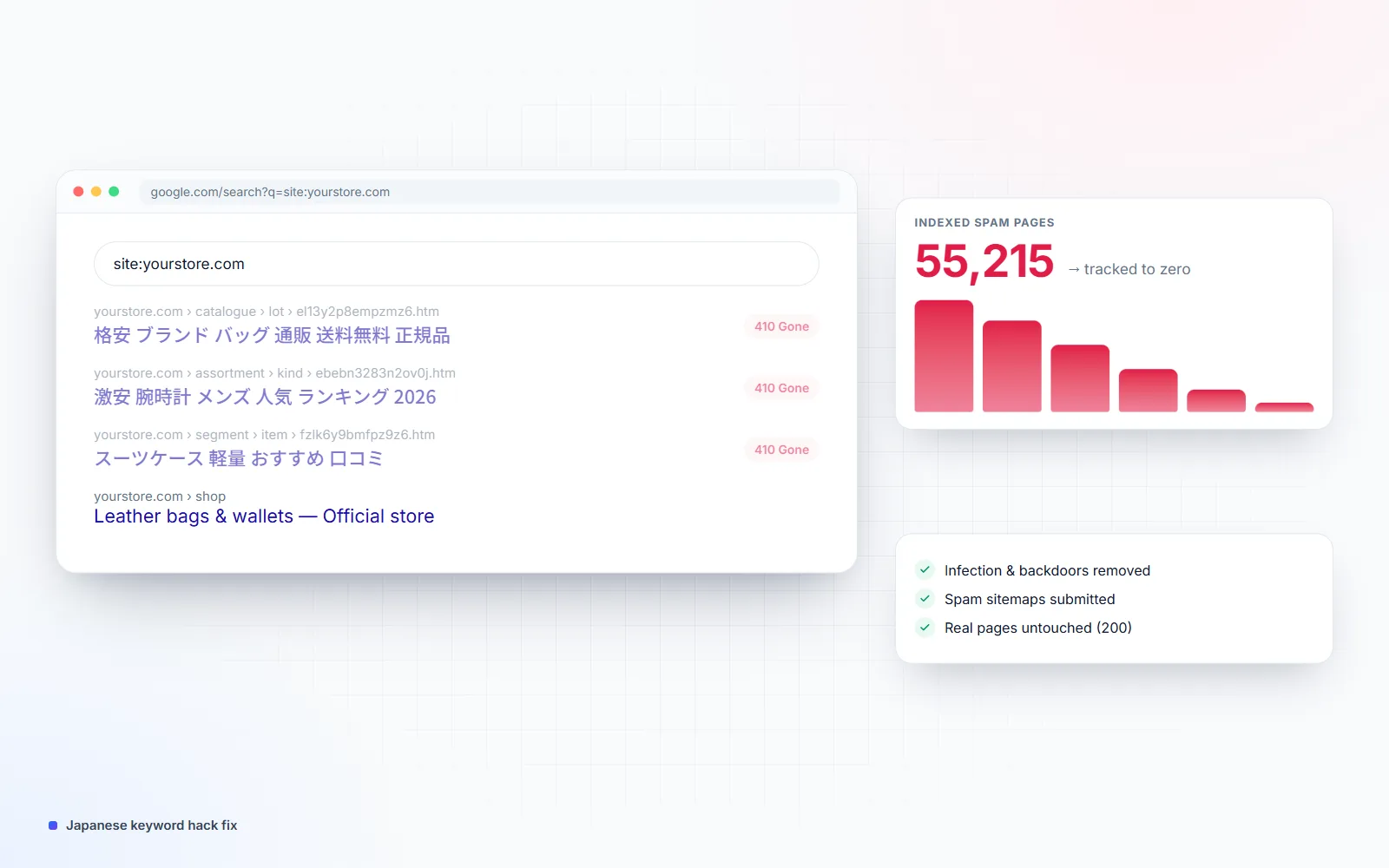
- spam URLs collected from server logs and resubmitted on one store
- 55,215
- spam pages indexed on a site I recovered
- 100,000+
- the status every spam URL returns after the cleanup
- 410
Is this you?
The problems this solves
Japanese text in your search results
Searching your domain shows pages with Japanese titles selling products you've never heard of.
Search Console shows Japan as a top country
Impressions and clicks suddenly come from Japan for queries in Japanese.
The spam came back after a cleanup
Files were cleaned, but spam pages keep appearing or stay in Google for months.
What you get
What's included
-
Infection and backdoor removal
Injected PHP, rogue .htaccess rules, fake plugins and database entries removed.
-
Spam URL pattern analysis
The URL patterns the hack used, identified from Search Console and server logs.
-
Server-level 410 rules
Every spam URL answers 410 Gone while all real pages keep working.
-
Spam sitemaps
Lists of spam URLs submitted in Search Console so Google re-crawls and drops them faster.
-
Index tracking
Indexed pages and Japanese queries tracked weekly until they're gone.
-
Hardening and report
The entry point closed, the site hardened and a written report delivered.
- Index Sentinel
- Google Search Console
- Bing Webmaster Tools
- server access logs
- WP-CLI
- .htaccess
- Cloudflare
Real projects
Proof from live websites

Process
How we work together
-
01
Confirm and back up
Confirm the hack, see what Google sees and back up the current state.
-
02
Clean the site
Remove the infection and backdoors and close the entry point.
-
03
Recover the index
410 rules, spam sitemaps and Search Console work.
-
04
Track to zero
Weekly tracking of indexed spam until it's cleared.
How the cleanup works
- See what Google sees. A site: search, Search Console’s indexed pages and country data, and pages fetched as Googlebot show the size and pattern of the spam.
- Remove the infection. I compare WordPress core, themes and plugins with clean copies, check the uploads folder, .htaccess files and the database, and remove injected code and backdoors.
- Close the entry point. Usually an outdated plugin or theme, a weak admin password or an old, forgotten install on the same hosting account.
- Answer every spam URL with 410 Gone. The hack’s URLs follow patterns, so a few server rules cover tens of thousands of pages without touching real ones.
- Help Google re-crawl. I collect the spam URLs from Search Console and server logs, put them in temporary spam sitemaps and submit them.
- Track until it’s gone, then remove the spam sitemaps.
The web.dev team’s guide to the Japanese keyword hack is a good overview of how this hack works. Below is how I handle it on WordPress, including the 410 and sitemap work that clears the spam from Google faster.
A real recovery: 55,215 spam URLs
On a leather brand’s WooCommerce store, the spam pages followed a pattern like /word/word/random-15-characters.htm. Googlebot was still requesting them tens of thousands of times. One server rule now answers all of them with 410 Gone, real pages return 200, and two spam sitemaps with 55,215 URLs taken from the server logs were submitted so Google drops them quickly. It’s part of my WordPress security and hack recovery service.
Pricing
How much does it cost?
Clear starting prices in USD. You get a fixed quote before any work starts, and nothing is billed until you approve it.
Standard Cleanup
From $450 per site
Up to about 50,000 spam URLs.
- Infection and backdoor removal
- 410 rules and spam sitemaps
- Search Console work
- 30 days of tracking
Large-Scale Recovery
From $850 per site
50,000+ spam URLs or several spam patterns.
- Everything in Standard
- Log analysis to collect every spam URL
- Multiple spam sitemaps
- 60 days of tracking
FAQ
Frequently asked questions
How do I check if my site has the Japanese keyword hack?
Search Google for site:yourdomain.com and look for Japanese titles, or open Search Console's Performance report and check whether Japan suddenly appears as a top country. Because the hack often shows spam only to Google, also use the URL Inspection tool to see the page as Googlebot does.
Why are the spam pages in Japanese?
The spammers sell counterfeit or affiliate products to Japanese searchers and use hacked sites with good reputations to rank. Your domain is borrowed for their traffic.
Should I use Google's Removals tool?
Only for a few urgent URLs. Removals are temporary (about six months) and limited in number. For thousands of spam pages, 410 responses plus spam sitemaps are the permanent fix.
Will my rankings come back after the cleanup?
In most cases, yes. Once Google stops wasting crawl budget on spam and sees your real pages again, rankings usually recover over the following weeks. Very large infections take longer.
Does disavowing links help?
Rarely. The problem is pages on your site, not links pointing to it. Disavowing is only worth considering if the hack also created large numbers of spammy backlinks.
Related services
All services →Seeing Japanese pages in Google for your site?
Send me your domain. I'll check what Google has indexed the same day and tell you how big the cleanup is.